


Director's Message — Message from the Director

When people think of Japan's relationship with the Middle East, oil is usually the first thing that comes to mind. Japan relies on imports for almost all of its oil, and roughly ninety per cent of that comes from the Middle East. The outbreak of the 1973 Arab–Israeli War (October War) was followed by an oil embargo and production cuts by Arab oil-producing countries, triggering the first oil crisis and profoundly affecting the Japanese economy.
Nearly half a century has passed since then, yet Japan still depends heavily on the Middle East for its energy. At the same time, emerging Asian economies have been expanding their presence in the region, and the economic structures linking Asia, the world and the Middle East — across energy, trade and investment — have changed substantially.
Japan's ties with Middle Eastern countries, which once focused predominantly on economics, have broadened into politics and culture as well. Japan has made significant contributions during various conflicts, including the Middle East peace process, the Gulf crises, and the Iraq War. Japanese anime, manga and video games are enthusiastically embraced by younger generations throughout the region.
At the same time, political and economic instability in the Middle East has been a constant. Since the 9/11 attacks, terrorist incidents have proliferated worldwide, claiming many Japanese lives. The Arab Spring toppled several governments, and the ensuing chaos has produced new threats and conflicts with no end in sight.
JIME Center was established in 1974 as the Middle East Economic Research Institute, shortly after the oil shock, to provide essential, timely information to companies operating in the region. Following its merger with the Institute of Energy Economics, Japan (IEEJ), it became a dedicated division of IEEJ. Our researchers — with extensive field experience and fluency in the languages of the region — work daily to analyse rapidly evolving developments.
Although instability in the Middle East deepens, the region's importance to Japan has not diminished. JIME Center remains committed to delivering timely analysis and policy recommendations on Middle East political economy. We are grateful for your continued support and guidance.
Our Approach
Origins of JIME Center
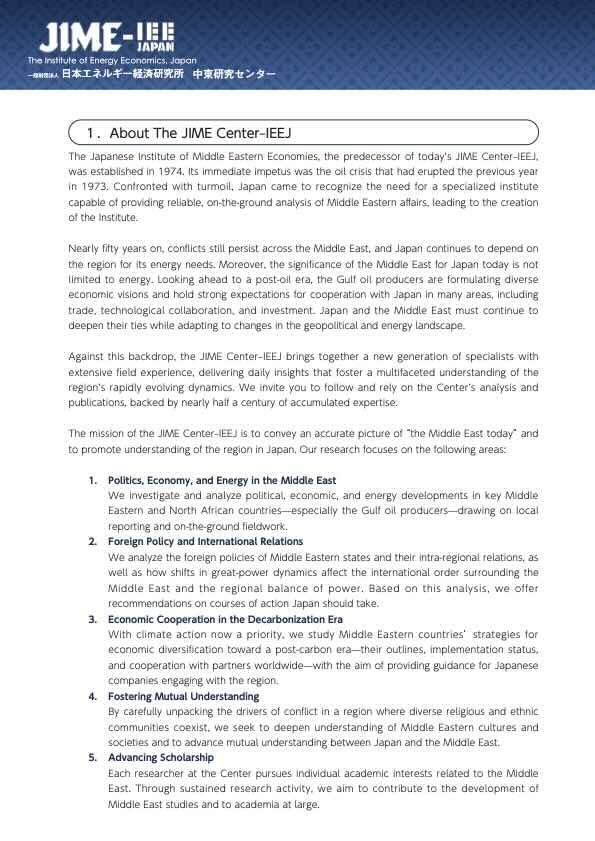
In April 2005, JIME Center re-launched as a dedicated division of the General Foundation Institute of Energy Economics, Japan (IEEJ), building on the 31-year track record of its predecessor, the Middle East Economic Research Institute. JIME Center is Japan's foremost specialist institution for research on the countries of the Middle East, including North Africa, examining each country's developments from political, economic, social, security and energy-security perspectives.
Understanding the reality of the Middle East
The Middle East is deeply intertwined with the Japanese economy through energy, trade, plant exports and other fields, and events across the region command attention in media worldwide. Yet the underlying realities and contextual background of individual countries rarely receive the scrutiny their importance demands.
Our mission
Drawing on specialist knowledge and decades of experience, we provide timely information and publications with a distinctively analytical perspective. We are especially committed to maintaining a structure that can respond swiftly to rapidly changing developments — publishing research findings promptly and offering data on Middle East affairs and energy issues in a form that can be applied in multiple ways.
Through these distinctive activities, JIME Center aims to contribute to the development of the Japanese economy. We look forward to your continued understanding and support of our work.
Business Overview
Basic Data
| Name | JIME Center, The Institute of Energy Economics, Japan (formerly Japanese Institute of Middle Eastern Economies) |
|---|---|
| Established | 1 April 2005 (predecessor: 10 September 1974) |
| Staff | 9 researchers |
Characteristics
- Japan's foremost specialist institution for comprehensive and practical research on the politics, economics, security and energy affairs of the Middle East and North Africa.
- Staff composed of specialists with extensive field experience and researchers seconded from related corporations.
- Systematic collection and databasing of relevant documents and data.
Research coverage
- Arab Middle East — 17 countries and 1 territory
- Non-Arab countries — Iran, Israel, Turkey
- Other — Oil and gas producing states
Organisation
JIME Center is the Middle East research division of The Institute of Energy Economics, Japan (IEEJ).
Organisation Chart

Information Disclosure
Statutory disclosure documents for a General Foundation are listed below.
- Articles of Incorporation (PDF) (Opens in a new window)
- List of Officers (PDF) (Opens in a new window)
- FY2025 Business Plan + Budget (PDF) (Opens in a new window)
- FY2023 Annual Business Report (PDF) (Opens in a new window)
- FY2023 Balance Sheet (PDF) (Opens in a new window)
For other requests, please contact us.